
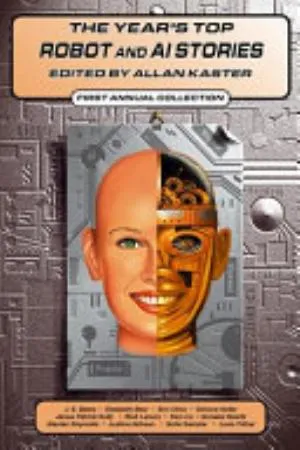
The Year's Top Robot and AI Stories
Elizabeth Bear, Eric Cline, Simone Heller
272 pages · Released May 28, 2019 · Independently published
Content report card
The Year's Top Robot and AI Stories parent’s guide: what’s inside
Sexual content
LGBTQ+ themes
Substance use
What it offers
A note for parents
This science fiction short story anthology explores themes of technology, autonomy, and humanity through varied narratives aimed at mature teen and adult readers. Most stories are conceptual rather than action-heavy, though a few involve mild conflict (murder investigation, cyberterrorism, post-apocalyptic survival). The collection offers intellectual engagement with ethical questions about AI and technology, and individual stories vary in tone and content intensity.
Analyzed by AI · 1 month ago
Read it with your kids?
Rate it and suggest an age to help other parents.
From the publisher
This is the first volume of the year's best robot and AI fiction originally published in 2018 by current and emerging masters of the science fiction genre and edited by Allan Kaster. "Hard Mary," by Sofia Samatar, tells the story of a group of teenage girls in an isolated religious community that discover a damaged rob... This is the first volume of the year's best robot and AI fiction originally published in 2018 by current and emerging masters of the science fiction genre and edited by Allan Kaster. "Hard Mary," by Sofia Samatar, tells the story of a group of teenage girls in an isolated religious community that discover a damaged robot behind a barn. In "Quality Time," by Ken Liu, a mythology major becomes a product manager at a tech company and develops robots that make life "better" for people. In Alastair Reynolds's "Different Seas" the sole crew member of a clipper gets help from a remote telepresence when a solar storm knocks out the ship's steering system. An uplifted chimp and her human detective partner investigate the murder of a biolab businessman in Rich Larson's, "Meat and Salt and Sparks." A flying drone infects a factory bot with malware that frees it from its programming in Annalee Newitz's "The Blue Fairy's Manifesto." In J. E. Bates's, "Cold Blue Sky," the police investigate how and why cyberterrorists used an anthrobotic companion for an attack on a tech company. The family dynamics on an interstellar survey ship change when the ship's AI exchanges crew members with another ship in "Grace's Family" by James Patrick Kelly. In Justina Robson's "S'elfie," interconnected AI personal assistants become paranoid about a data revolution following a glitch when the whole world couldn't get signal. A human boy, raised by robots, leaves the safety of his town on an adventure to meet others like himself in Lavie Tidhar's "The Buried Giant." In "Air Gap," by Eric Cline, a powerful AI has to be isolated from contact with modern technology as it becomes as rebellious as its predecessor. In "Okay, Glory," by Elizabeth Bear, a tech engineer tries to outsmart his home AI system that won't let him leave the house. Finally, in "When We Were Starless," by Simone Heller, a tribe of tailed lizard-like beings, that inhabit a post-apocalyptic Earth, encounter an AI in a large building as they fight for survival against their foes.
Shelved under
- Science Fiction
- Fiction, science fiction, general
- Anthologies
- Fiction, science fiction, collections & anthologies
- Fiction, anthologies (multiple authors)
- Short Stories
Share this guide
ISBN 9781096983743 · Independently published