
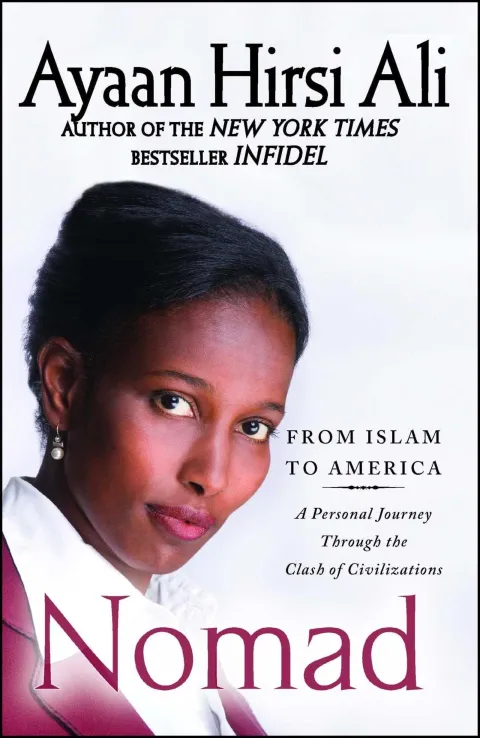
Nomad
From Islam to America: A Personal Journey Through the Clash of Civilizations
Readers rate it 3.5 (6 on Hardcover)
320 pages · Released 2010 · Simon and Schuster
Content report card
Nomad parent’s guide: what’s inside
LGBTQ+ themes
Substance use
What it offers
A note for parents
This is an adult political memoir and intellectual autobiography not designed for young readers. While powerful and well-intentioned, it contains references to violence (including female genital mutilation and death threats), discussions of sexual practices and arranged marriage, and heavy themes including religious fundamentalism and family trauma. The book's value lies in its educational content about Islam, immigration, and women's rights, along with modeling intellectual courage and resilience, but these require maturity to contextualize properly.
Analyzed by AI · 1 month ago
Read it with your kids?
Rate it and suggest an age to help other parents.
From the publisher
"This woman is a major hero of our time." —Richard Dawkins Ayaan Hirsi Ali captured the world’s attention with Infidel, her compelling coming-of-age memoir, which spent thirty-one weeks on the New York Times bestseller list. Now, in Nomad, Hirsi Ali tells of coming to America to build a new life, an ocean away from the... "This woman is a major hero of our time." —Richard Dawkins Ayaan Hirsi Ali captured the world’s attention with Infidel, her compelling coming-of-age memoir, which spent thirty-one weeks on the New York Times bestseller list. Now, in Nomad, Hirsi Ali tells of coming to America to build a new life, an ocean away from the death threats made to her by European Islamists, the strife she witnessed, and the inner conflict she suffered. It is the story of her physical journey to freedom and, more crucially, her emotional journey to freedom—her transition from a tribal mind-set that restricts women’s every thought and action to a life as a free and equal citizen in an open society. Through stories of the challenges she has faced, she shows the difficulty of reconciling the contradictions of Islam with Western values. In these pages Hirsi Ali recounts the many turns her life took after she broke with her family, and how she struggled to throw off restrictive superstitions and misconceptions that initially hobbled her ability to assimilate into Western society. She writes movingly of her reconciliation, on his deathbed, with her devout father, who had disowned her when she renounced Islam after 9/11, as well as with her mother and cousins in Somalia and in Europe. Nomad is a portrait of a family torn apart by the clash of civilizations. But it is also a touching, uplifting, and often funny account of one woman’s discovery of today’s America. While Hirsi Ali loves much of what she encounters, she fears we are repeating the European mistake of underestimating radical Islam. She calls on key institutions of the West—including universities, the feminist movement, and the Christian churches—to enact specific, innovative remedies that would help other Muslim immigrants to overcome the challenges she has experienced and to resist the fatal allure of fundamentalism and terrorism. This is Hirsi Ali’s intellectual coming-of-age, a memoir that conveys her philosophy as well as her experiences, and that also conveys an urgent message and mission—to inform the West of the extent of the threat from Islam, both from outside and from within our open societies. A celebration of free speech and democracy, Nomad is an important contribution to the history of ideas, but above all a rousing call to action.
Shelved under
- Biography & Autobiography
- Biography
- Family
- Netherlands
- Netherlands. Staten-Generaal
- Women social reformers
- Somalis
- Social aspects
- Civil rights
- Women refugees
- Muslim women
- Islam
Share this guide
ISBN 9781439157329 · Simon and Schuster