
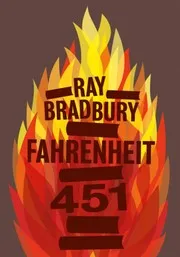
Fahrenheit 451
Readers rate it 3.9 (5.4K on Hardcover)
240 pages · Released 2013 · HarperVoyager
Content report card
Fahrenheit 451 parent’s guide: what’s inside
LGBTQ+ themes
What it offers
A note for parents
Fahrenheit 451 is a classic dystopian novel exploring themes of censorship, knowledge, and individual freedom through the story of a fireman who questions his role in burning books. While the content is not graphically violent or explicit, the book's mature political themes, depiction of a totalitarian state, and psychological tension make it most appropriate for teen readers who can engage with its ideas. The story ultimately champions critical thinking, literature, and resistance to oppression, offering significant educational and philosophical value.
Analyzed by AI · 1 month ago
Read it with your kids?
Rate it and suggest an age to help other parents.
From the publisher
Fahrenheit 451 is a 1953 dystopian novel by American writer Ray Bradbury. Often regarded as one of his best works, the novel presents a future American society where books are outlawed and "firemen" burn any that are found. The book's tagline explains the title as "'the temperature at which book paper catches fire, and... Fahrenheit 451 is a 1953 dystopian novel by American writer Ray Bradbury. Often regarded as one of his best works, the novel presents a future American society where books are outlawed and "firemen" burn any that are found. The book's tagline explains the title as "'the temperature at which book paper catches fire, and burns": the autoignition temperature of paper. The lead character, Guy Montag, is a fireman who becomes disillusioned with his role of censoring literature and destroying knowledge, eventually quitting his job and committing himself to the preservation of literary and cultural writings. The novel has been the subject of interpretations focusing on the historical role of book burning in suppressing dissenting ideas for change. In a 1956 radio interview, Bradbury said that he wrote Fahrenheit 451 because of his concerns at the time (during the McCarthy era) about the threat of book burning in the United States. In later years, he described the book as a commentary on how mass media reduces interest in reading literature. In 1954, Fahrenheit 451 won the American Academy of Arts and Letters Award in Literature and the Commonwealth Club of California Gold Medal. It later won the Prometheus "Hall of Fame" Award in 1984 and a "Retro" Hugo Award, one of a limited number of Best Novel Retro Hugos ever given, in 2004. Bradbury was honored with a Spoken Word Grammy nomination for his 1976 audiobook version. --- Also contained in: - 451° по Фаренгейту: Рассказы - 451° по Фаренгейту: повести и рассказы - Works
Shelved under
- Mechanical Hound
- girl next door
- Long Now Manual for Civilization
- Terrorismo estatal
- Censura
- Novela
- Totalitarismo
- science fiction
- political fiction
- satire
- Zukunft
- State-sponsored terrorism
Share this guide
ISBN 9780007491568 · HarperVoyager